Mechanically
Braking systems use devices to gain a mechanical advantage. The most common device for this purpose is leverage (Fig. 3).
A lever is placed on a pivot called the fulcrum. If the distance from A to C is four metres, and from C to B one metre, the ratio is four to one (4:1). Power is multiplied by the leverage principle. If a 100 kg downward force is applied at point A, then upward force at point B is 400 kg. This is the result of the mechanical advantage of leverage.


Use of air
Force can also be multiplied by the use of air to gain a further mechanical advantage. Everyone has felt the power of air on a windy day. Air can be compressed into a much smaller space than it normally occupies. For instance, air is compressed in tires to support the weight of a vehicle. The smaller the space into which air is squeezed, the greater the air’s resistance to being squeezed. This resistance creates pressure, which is used to gain mechanical advantage.
If a constant supply of compressed air is directed through a pipe that is one-inch square, and if a one-square-inch plug was placed in the pipe, the compressed air would push against the plug. Holding a scale against the plug would register how many pounds of force were being exerted by the air against the plug.
If the scale registered 10 lb., for example, then it could be said the force was 10 lb. on the one-square-inch surface of the plug (Fig. 5). This would be 10 lb. per square inch (psi).
The more the air in the supply tank has been compressed, the greater the force that would be exerted on the face of the plug.

Leverage and air pressure
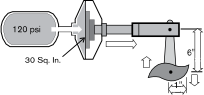
In actual operation, pipes are round and plugs are diaphragms of flexible material acting against push rods. If compressed air of 120 psi acts on a diaphragm of 30 square inches (Fig. 6), 3,600 lb. of force is produced (120 x 30). Apply this force to a push rod to move a six-inch slack adjuster operating a cam, and the total force equals 21,600 inch pounds torque (3,600 x 6), or 1,800 foot pounds torque (21,600 ÷ 12). It requires between 80 and 100 foot pounds of torque to tighten the wheel on a car. This comparison illustrates the power obtained from using mechanical leverage and air pressure combined.